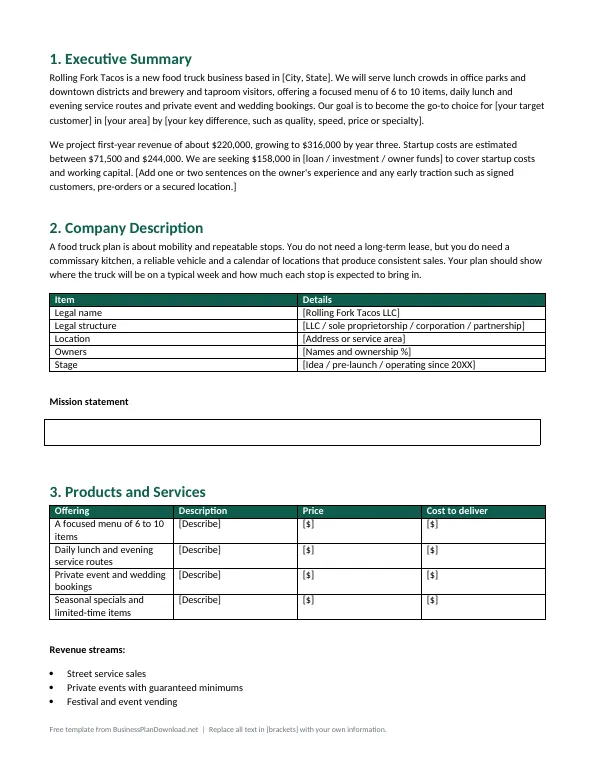
What is inside this food truck business plan
The download is a complete sample plan for Rolling Fork Tacos, a fictional food truck business, written so you can see what a finished plan looks like and then swap in your own details. It includes all twelve sections lenders and investors expect:
- Executive summary
- Company description
- Products and services
- Market analysis
- Competition
- Marketing and sales
- Operations, licenses and permits
- Management and staffing
- Key performance indicators
- Risks and mitigation
- Financial plan with startup costs and 3-year projection
- Funding request and appendix checklist
Who your food truck business will serve
Typical customers
- Lunch crowds in office parks and downtown districts
- Brewery and taproom visitors
- Festival, fair and farmers market attendees
- Private party and corporate catering clients
Products and services to describe
- A focused menu of 6 to 10 items
- Daily lunch and evening service routes
- Private event and wedding bookings
- Seasonal specials and limited-time items
Common revenue streams
- Street service sales
- Private events with guaranteed minimums
- Festival and event vending
Food Truck startup costs
These rough ranges are a starting point for your own budget. Real costs depend heavily on your city, the size of the operation and whether you buy new or used. Get quotes and replace them in your plan.
| Startup cost | Typical low | Typical high |
|---|---|---|
| Truck or trailer (used or new) | $40,000 | $150,000 |
| Kitchen outfitting and wrap | $15,000 | $50,000 |
| Commissary kitchen deposit | $500 | $2,000 |
| Permits, licenses and inspections | $1,500 | $5,000 |
| POS system and payment hardware | $500 | $2,000 |
| Opening inventory and supplies | $2,000 | $5,000 |
| Insurance (first year) | $2,000 | $5,000 |
| Working capital reserve | $10,000 | $25,000 |
| Estimated total | $71,500 | $244,000 |
Build your own budget with the free startup costs calculator.
Sample 3-year projection
The template includes an illustrative projection for a food truck business with first-year revenue of $220,000 and a 66% gross margin. Use it to see the shape of the numbers, then build your own with the 3-year financial projections spreadsheet.
| Year 1 | Year 2 | Year 3 | |
|---|---|---|---|
| Revenue | $220,000 | $275,000 | $316,000 |
| Gross profit | $145,200 | $181,500 | $208,560 |
| Operating expenses | $137,940 | $151,734 | $163,873 |
| Net income before tax | $7,260 | $29,766 | $44,687 |
Key numbers to track
- Sales per service
- Average revenue for each stop, which shows which locations to keep.
- Food cost percentage
- Most trucks aim for 25 to 35%.
- Event booking rate
- Share of revenue from private bookings, which is more predictable than street service.
- Customers per hour
- Ticket speed during peak service limits how much you can sell.
Licenses and permits to research
- Mobile food vending permit
- Health department inspection of the truck
- Commissary agreement
- Fire safety inspection for propane and cooking equipment
- Commercial vehicle registration and insurance
Requirements differ by state, county and city. Check with your local business licensing office, health department or Small Business Development Center before you open.
Marketing ideas for a food truck business
- Post your weekly schedule on Instagram and Google Business Profile
- Join local food truck associations and rallies
- Offer brewery partnerships with recurring nights
- Collect emails or texts for location alerts
Risks lenders will ask about
- Vehicle breakdowns that stop all revenue
- Weather and seasonality
- City rules on where trucks may park
- Event fees that eat into margins
Tips for writing your food truck business plan
- Include a sample weekly route with expected covers at each stop.
- Show a maintenance and backup plan for the vehicle.
- Separate private-event revenue from street sales in your forecast.
Prefer a guided version?
Answer questions one section at a time and download your finished plan as a Word file.
Frequently asked questions
How much does it cost to start a food truck?
Most new food trucks cost between $75,000 and $200,000 to launch once the vehicle, kitchen build, permits and a cash reserve are included. A used trailer can bring that number down considerably.
Do food trucks need a business plan?
Yes, especially if you plan to finance the truck. Lenders want to see your route plan, permit status, menu costs and how many sales you need per day to break even.
Is this food truck business plan template really free?
Yes. Download the Word or PDF file and use it for your own business at no cost, with no sign-up required. Replace the example text and numbers with your own.
Related business plan samples
Restaurant Business Plan
A restaurant plan has to prove two things at once: that people in a specific neighborhood want this food at...
Food & HospitalityBakery Business Plan
Bakeries live on early mornings, consistent quality and a loyal neighborhood following.
Food & HospitalityCoffee Shop Business Plan
Coffee shops sell a low-priced product many times a day, so the plan hinges on traffic, ticket size and speed.
Food & HospitalityCatering Business Plan
Catering companies sell by the event rather than by the plate, which makes the sales pipeline and booking...
Food & HospitalitySpecialty Food Product Business Plan
Packaged food businesses such as sauces, snacks, jams and baked goods sold through stores have a different...
Food & HospitalityBrewery and Taproom Business Plan
Breweries require serious capital and long licensing timelines, so plans are reviewed carefully by lenders...