What is inside this restaurant business plan
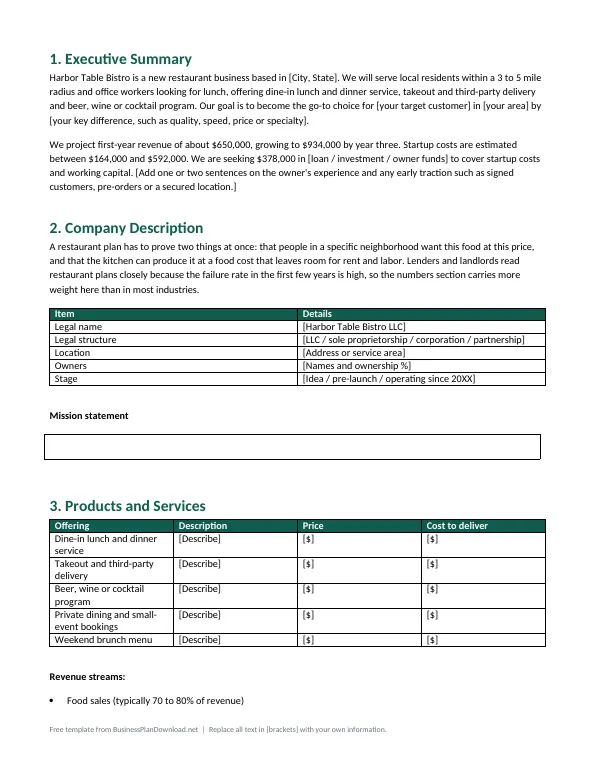
The download is a complete sample plan for Harbor Table Bistro, a fictional restaurant business, written so you can see what a finished plan looks like and then swap in your own details. It includes all twelve sections lenders and investors expect:
- Executive summary
- Company description
- Products and services
- Market analysis
- Competition
- Marketing and sales
- Operations, licenses and permits
- Management and staffing
- Key performance indicators
- Risks and mitigation
- Financial plan with startup costs and 3-year projection
- Funding request and appendix checklist
Who your restaurant business will serve
Typical customers
- Local residents within a 3 to 5 mile radius
- Office workers looking for lunch
- Weekend diners and families
- Private event and catering clients
Products and services to describe
- Dine-in lunch and dinner service
- Takeout and third-party delivery
- Beer, wine or cocktail program
- Private dining and small-event bookings
- Weekend brunch menu
Common revenue streams
- Food sales (typically 70 to 80% of revenue)
- Beverage and alcohol sales, usually the highest-margin line
- Catering and private events
Restaurant startup costs
These rough ranges are a starting point for your own budget. Real costs depend heavily on your city, the size of the operation and whether you buy new or used. Get quotes and replace them in your plan.
| Startup cost | Typical low | Typical high |
|---|---|---|
| Lease deposit and build-out | $60,000 | $250,000 |
| Kitchen equipment | $40,000 | $120,000 |
| Furniture, fixtures and POS | $15,000 | $45,000 |
| Licenses, permits and liquor license | $3,000 | $40,000 |
| Opening food and beverage inventory | $8,000 | $20,000 |
| Pre-opening payroll and training | $10,000 | $30,000 |
| Marketing and grand opening | $3,000 | $12,000 |
| Working capital reserve | $25,000 | $75,000 |
| Estimated total | $164,000 | $592,000 |
Build your own budget with the free startup costs calculator.
Sample 3-year projection
The template includes an illustrative projection for a restaurant business with first-year revenue of $650,000 and a 68% gross margin. Use it to see the shape of the numbers, then build your own with the 3-year financial projections spreadsheet.
| Year 1 | Year 2 | Year 3 | |
|---|---|---|---|
| Revenue | $650,000 | $812,000 | $934,000 |
| Gross profit | $442,000 | $552,160 | $635,120 |
| Operating expenses | $419,900 | $461,890 | $498,841 |
| Net income before tax | $22,100 | $90,270 | $136,279 |
Key numbers to track
- Food cost percentage
- Cost of ingredients divided by food sales. Most full-service restaurants target 28 to 35%.
- Prime cost
- Food, beverage and labor costs combined. Keeping this near 60% of sales is a common benchmark.
- Table turnover
- How many times each table seats a new party during a service.
- Average check
- Revenue per guest, which tells you whether upselling and menu pricing are working.
Licenses and permits to research
- Business license and EIN
- Food service establishment permit from the local health department
- Certificate of occupancy and fire inspection
- Liquor license, if serving alcohol
- Food handler and manager certifications
Requirements differ by state, county and city. Check with your local business licensing office, health department or Small Business Development Center before you open.
Marketing ideas for a restaurant business
- Google Business Profile with menu, hours and photos
- Soft opening for neighbors and local press
- Loyalty program or email list from day one
- Partnerships with nearby offices and event venues
- Instagram content built around signature dishes
Risks lenders will ask about
- Thin margins that leave little room for slow months
- Rising food and labor costs
- Staff turnover and training time
- Location and foot traffic assumptions that prove optimistic
Tips for writing your restaurant business plan
- Show a sample menu with prices and the plated food cost of your top sellers.
- Include a floor plan with seat count, because seats times turns drives your revenue forecast.
- Explain how you will cover the first six months if sales ramp slowly.
Prefer a guided version?
Answer questions one section at a time and download your finished plan as a Word file.
Frequently asked questions
How much does it cost to open a restaurant?
Small counter-service spots can open for under $150,000 in an existing space, while full-service restaurants with a new build-out often run $250,000 to $750,000 or more. Location, build-out and the liquor license drive most of the difference.
What should a restaurant business plan include?
An executive summary, concept and menu, location analysis, competitive review, marketing plan, staffing plan, startup budget and at least three years of projected sales, food cost, labor and cash flow.
Is this restaurant business plan template really free?
Yes. Download the Word or PDF file and use it for your own business at no cost, with no sign-up required. Replace the example text and numbers with your own.
Related business plan samples
Food Truck Business Plan
A food truck plan is about mobility and repeatable stops.
Food & HospitalityBakery Business Plan
Bakeries live on early mornings, consistent quality and a loyal neighborhood following.
Food & HospitalityCoffee Shop Business Plan
Coffee shops sell a low-priced product many times a day, so the plan hinges on traffic, ticket size and speed.
Food & HospitalityCatering Business Plan
Catering companies sell by the event rather than by the plate, which makes the sales pipeline and booking...
Food & HospitalitySpecialty Food Product Business Plan
Packaged food businesses such as sauces, snacks, jams and baked goods sold through stores have a different...
Food & HospitalityBrewery and Taproom Business Plan
Breweries require serious capital and long licensing timelines, so plans are reviewed carefully by lenders...